
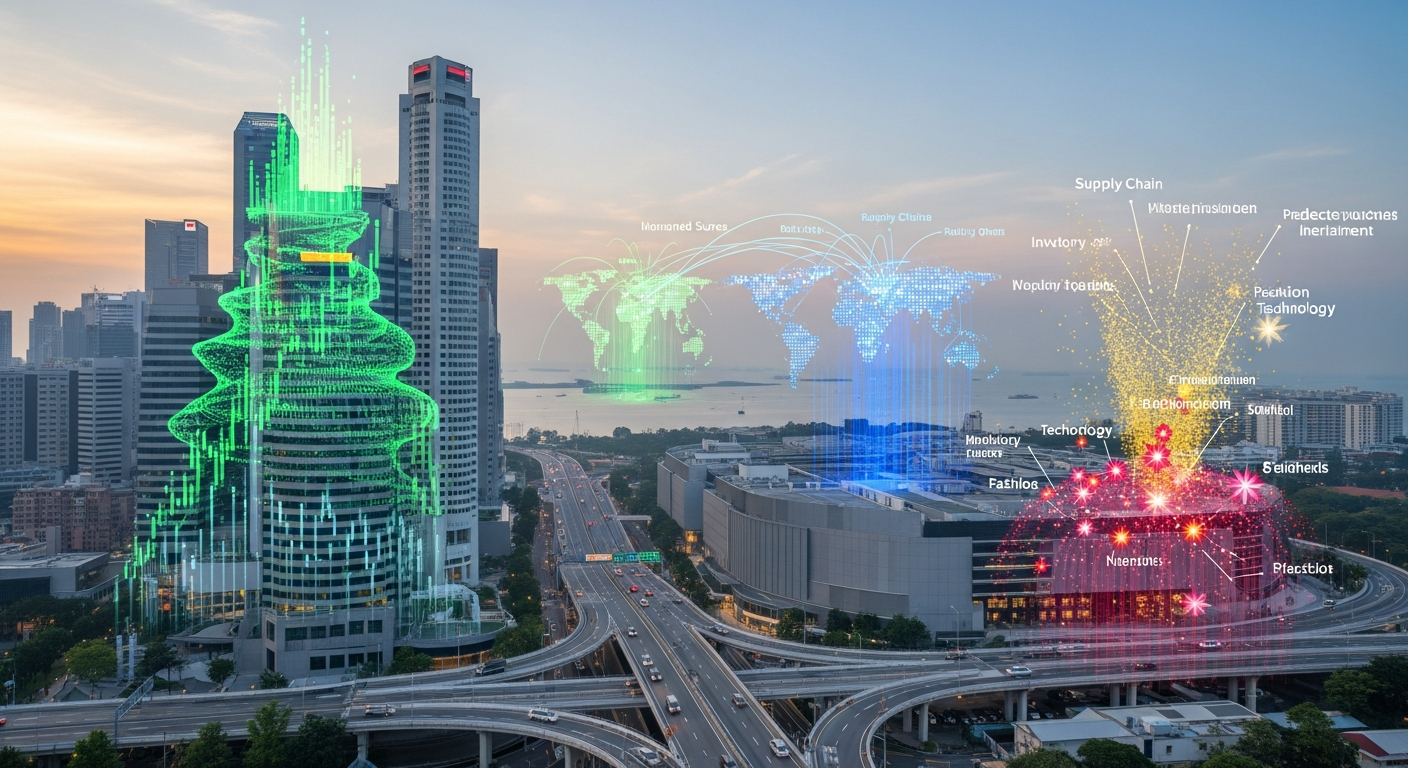
The global business landscape is on the cusp of a radical transformation, driven by the emergent forces of Agentic AI and Quantum Computing. Beyond the current capabilities of large language models, these advanced technologies are converging to offer unprecedented levels of automation, optimization, and problem-solving. This deep dive explores how this synergy is not only reshaping existing industries but also creating entirely new paradigms for efficiency, innovation, and strategic advantage, while simultaneously presenting novel risks that demand proactive management from business leaders and strategists worldwide.

Trend Analysis: Market Dynamics and Transformative Drivers
The acceleration of Agentic AI and Quantum Computing marks a pivotal shift in the technological foundation of global commerce. These fields are characterized by explosive growth, significant investment, and the emergence of specialized leaders, all underpinned by profound technological advancements and societal demands for increased efficiency and problem-solving capabilities.
Market Overview and Key Players
The Agentic AI market is experiencing remarkable expansion. Valued between approximately $5.25 billion and $5.78 billion globally in 2024, the enterprise segment alone is estimated at $2.58 billion. Projections indicate a compound annual growth rate (CAGR) of 40.50% to 44.21% from 2025 through 2033 or 2034, pushing the market to an estimated $52 billion by 2030 and potentially reaching $199.05 billion by 2034. North America currently dominates this sector, accounting for 38% to 46% of the global market share in 2024.
Similarly, the Quantum Computing market, assessed at $1.06 billion to $2.7 billion in 2024, is set for substantial growth. Forecasts suggest a CAGR of 20.5% to 41.8% from 2025 through 2030 or 2035, with market values potentially reaching $4.24 billion to $20.2 billion by 2030, and up to $17.15 billion by 2034, or $19.44 billion by 2035. North America is also a frontrunner in this space, holding a 31.01% market share in 2024, with some reports even projecting a 61% share by 2025.
Leading the charge in **Agentic AI** are innovators such as OpenAI (with its GPT models and autonomous AI tools), Microsoft (Copilot, AutoGen, Azure AI), Anthropic (Claude AI), Google DeepMind (Gemini), Adept AI (ACT-1), Cognition Labs (Devin), AWS (Bedrock), IBM (Watsonx Orchestrate), UiPath, Aisera, and Moveworks. In **Quantum Computing**, key players include IBM, Google Quantum AI, IonQ, D-Wave, Quantinuum, and Rigetti Computing, all focused on developing foundational hardware, software, and cloud-based solutions.
Technical Drivers and Societal Context
The rise of Agentic AI is primarily fueled by the escalating demand for intelligent automation, enhanced decision-making, and increased efficiency across enterprise operations. This is made possible by continuous advancements in machine learning (ML), multi-agent systems, natural language processing (NLP), reinforcement learning, and sophisticated algorithms. Agentic AI systems are designed to understand context, set goals, and autonomously execute actions, significantly reducing the need for constant human oversight. This capability translates into faster operational speeds, automated tasks like coding and bug fixing, and integration into core functions such as customer service and software development, yielding cost savings, improved accuracy, and accelerated productivity.
Quantum Computing’s progression is driven by innovations in quantum hardware—manifested in an increasing number and quality of qubits and advancements in error correction—coupled with greater cloud-based accessibility and substantial public and private sector R&D investments. Harnessing quantum mechanical phenomena like superposition and entanglement, quantum computers promise to tackle problems far beyond the reach of classical supercomputers. This opens doors for revolutionary breakthroughs in fields such as cryptography, materials science, complex simulations, optimization challenges, and drug discovery.
The most profound impact, however, lies in the **convergence of Agentic AI and Quantum Computing**. This fusion promises hybrid systems capable of redefining computing and solving previously intractable problems. Quantum computing can dramatically accelerate AI’s computational bottlenecks, such as high-dimensional feature space mapping and complex generative modeling, by exponentially speeding up the training of specific deep learning models. Conversely, AI plays a crucial role in stabilizing quantum hardware, improving quantum control, and mitigating errors, thus fostering a symbiotic relationship that propels both technologies forward.

The Big Picture & Strategy
- Embrace Hyper-Automation with Agentic AI: Prioritize the strategic deployment of Agentic AI across complex workflows—from customer service to supply chain management—to unlock substantial cost efficiencies, enhance accuracy, and reallocate human capital to higher-value, innovative tasks.
- Invest in Quantum-Accelerated R&D: Explore and invest in hybrid quantum-classical solutions for critical R&D challenges. This convergence offers unparalleled opportunities for breakthroughs in drug discovery, advanced materials, and complex system optimization, creating new products and services in high-value industries.
- Reimagine Business Models for Personalization: Leverage autonomous agents and their predictive capabilities to deliver hyper-personalized customer experiences and cultivate entirely new service offerings. Develop niche-specific agents to disrupt existing markets and create new revenue streams.
Future Outlook: Evolution and Strategic Imperatives for 3-5 Years
Over the next three to five years, both Agentic AI and Quantum Computing will see significant evolution, with their convergence gaining critical momentum. Agentic AI systems are projected to become more sophisticated, accessible, and deeply embedded within core business processes. We anticipate a shift from single-agent applications to complex multi-agent systems that can autonomously manage ente